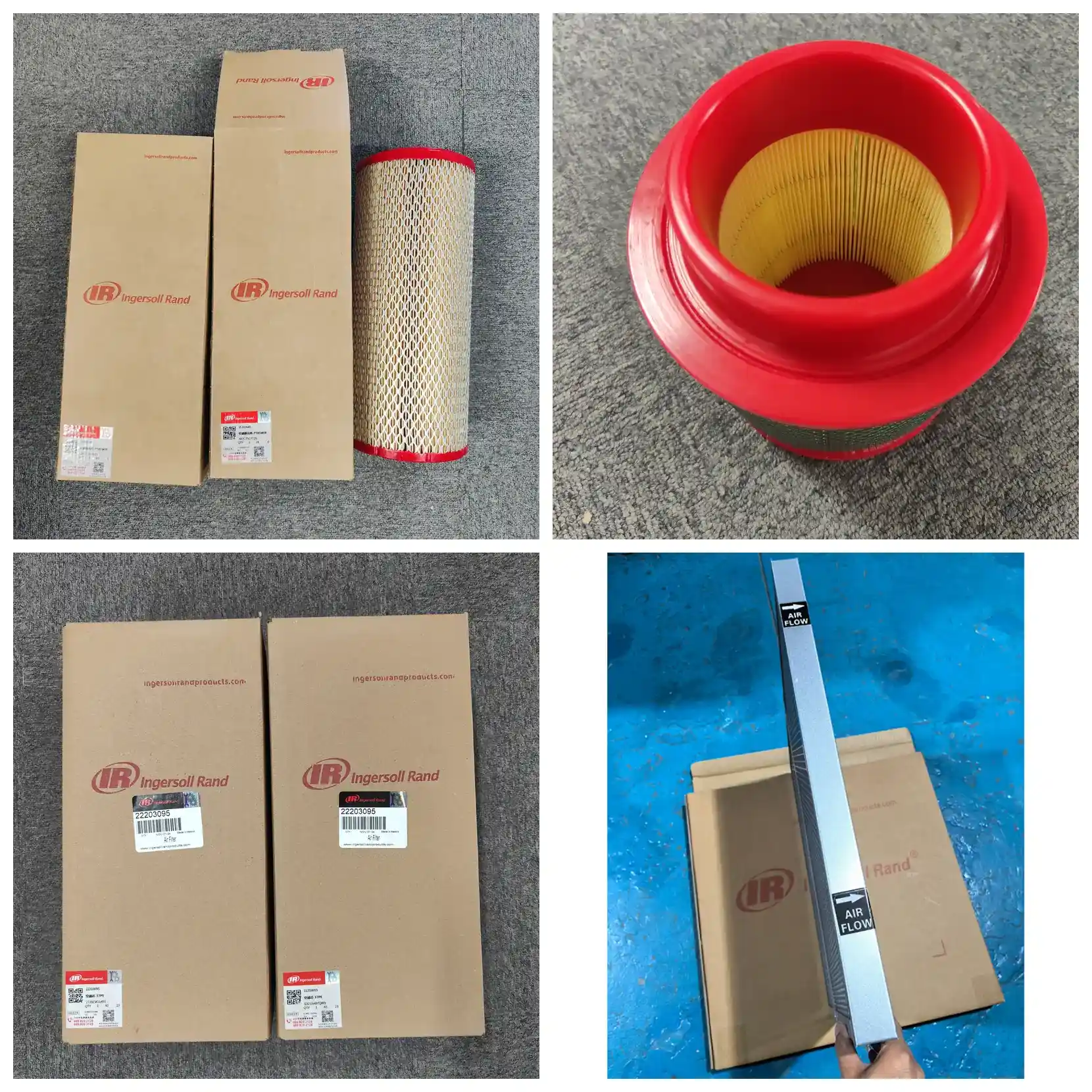
Product
Ingersoll Rand 99273906 Air Filter Element | M37 Compressor OEM Part
Genuine Ingersoll Rand 99273906 air filter element for M37 rotary screw compressors rated 6 m³/min at 0.7 MPa. 270 mm OD × 120 mm H, 2–10 μm filtration, ≥98% efficiency at ≥5 μm, and a 2,000-hour service interval. Export-ready with OEM/ODM support and full traceability by part number.
- Export packaging & documentation support
- OEM / ODM customization available
- Sample and bulk order workflow
Product Overview
99273906 is the intake air filter element for the Ingersoll Rand M37 rotary screw air compressor. It mounts inside the air filter housing at the compressor intake, upstream of the inlet valve. As the machine draws in ambient air, dust, sand, fibers, water mist, and oil mist are captured by the filter media — surface filtration stops larger particles while depth filtration traps finer ones. Only clean air reaches the rotor mesh zone.
Filter condition directly affects airend life. Hard particles that pass through an unfiltered intake accelerate wear on rotors and bearings and contaminate the downstream oil separator element, oil filter, and lubricant, shortening all three. A severely clogged element restricts intake flow, reducing discharge volume and raising energy consumption; in extreme cases, oil carryover can cause the airend to seize. Replacing the air filter on schedule is the lowest-cost protection available for the airend.
Core Specifications
| Item | Value |
|---|---|
| Part Number | 99273906 |
| Product Name | Air Filter Element |
| Applicable Model | Ingersoll Rand M37 rotary screw compressor |
| Machine Discharge | 6 m³/min @ 0.7 MPa |
| Outer Diameter | 270 mm |
| Height | 120 mm |
| Effective Filtration Area | Approx. 1.3 m² |
| Filtration Rating | 2–10 μm |
| Filtration Efficiency | ≥98% for particles ≥5 μm |
| Initial Pressure Drop | Approx. 0.5–1.0 kPa |
| Alarm Resistance | 6.0–6.5 kPa |
| Recommended Replacement | Approx. 2,000 hours or 3 months (adjust to operating conditions) |
Technical Parameters
1. Filtration Performance
| Parameter | Value / Notes |
|---|---|
| Filtration Rating | 2–10 μm |
| Filtration Efficiency | ≥98% for particles ≥5 μm |
| Filter Class | Not classified under EN 779 G/M/F ventilation filter grades; air filter elements are characterized per ISO 5011 by efficiency, intake resistance, and dust holding capacity |
| Dust Holding Capacity | Approx. 380 g |
2. Flow and Resistance
| Parameter | Value / Notes |
|---|---|
| Rated Air Flow | Matched to M37 discharge of 6 m³/min @ 0.7 MPa |
| Face Velocity | Approx. 0.077 m/s |
| Initial Pressure Drop | Approx. 0.5–1.0 kPa |
| Operating Differential Range | Approx. 1.0–6.0 kPa |
| Alarm / Final Resistance | 6.0–6.5 kPa |
| Pressure Drop vs. Energy | Every 1 kPa increase in intake resistance raises machine energy consumption by approx. 1% |
Pressure Drop and Energy: The Numbers
At an M37 discharge pressure of 0.7 MPa (gauge) and atmospheric pressure of 101.3 kPa, intake resistance raises the compression ratio:
| Intake Resistance | Compression Ratio | Relative Energy Increase |
|---|---|---|
| 0 kPa (new element) | 7.91 | Baseline |
| 2 kPa | 8.07 | +2.0% |
| 4 kPa | 8.24 | +4.1% |
| 6 kPa (near alarm) | 8.41 | +6.3% |
Over the life of one element (0 → 6 kPa), machine energy consumption climbs by roughly 6%. For a 37 kW machine running 6,000 hours per year, that means sustained extra power draw in the later stage of element life. The money saved by running a clogged element is far less than the added electricity cost.
3. Dimensions and Installation
| Parameter | Value / Notes |
|---|---|
| Dimensions | Outer diameter 270 mm × height 120 mm |
| Construction | Pleated (folded filter paper) |
| Effective Filtration Area | Approx. 1.3 m² |
| Pleat Count | Approx. 150 |
| Pleat Spacing | Approx. 4.8 mm |
| Mounting Interface | End-cap located, matched to M37 air filter assembly |
| Sealing | Face seal (axial compression) |
Procurement note: When cross-referencing replacements, the two most direct comparison dimensions are outer diameter 270 mm and height 120 mm. The ML37 / MU37 models in the same series use 39588777 (130 mm OD × 250 mm H) — the size difference is substantial and the two are not interchangeable.
4. Material Construction
| Parameter | Value / Notes |
|---|---|
| Filter Media | Imported wood pulp filter paper (industry-common US HV or Korean Ahlstrom media) |
| Media Weight | Approx. 130 g/m² |
| Inner/Outer Support | Galvanized steel perforated cage, approx. 0.6 mm thickness, open area ≥45% |
| End Caps | Metal end caps (galvanized steel) with polyurethane adhesive |
| Seal | Nitrile rubber (NBR) gasket |
| Bonding | Polyurethane (PU) hot-melt adhesive |
5. Operating Tolerance
| Parameter | Value / Notes |
|---|---|
| Operating Temperature | −10 to +100 °C |
| Relative Humidity | ≤80% RH, no condensation |
| Burst Strength | Filter paper burst strength approx. 200–400 kPa (per ISO 2758 paper burst test) |
| Collapse Resistance | Element designed for differential pressure ≥10 kPa |
| Special Functions | No flame-retardant, anti-static, or moisture-proof ratings specified for this model |
6. Service Life and Maintenance
| Parameter | Value / Notes |
|---|---|
| Service Life | Approx. 2,000 hours or 3 months |
| Actual Replacement Interval | Reduce to under 1,000 hours in dusty, sandy, or humid environments; follow the pressure differential alarm |
| Shelf Life | Approx. 2–3 years (unopened, dry, ventilated storage) |
7. Applicable Standards
| Item | Content |
|---|---|
| Product Standard | ISO 5011 (inlet air cleaning equipment for internal combustion engines and compressors — performance testing), evaluated by filtration efficiency, intake resistance, and dust holding capacity |
| Commonly Cited Test Standards | ISO 2941 / 2942 / 2943 / 3723 / 3724 / 3968 |
| Standard Applicability Note | The ISO 29xx / 37xx series are general test methods for hydraulic fluid power filter elements (burst resistance, structural integrity, material compatibility, axial load, flow fatigue, pressure drop vs. flow). If a supplier can only provide hydraulic filter standards, request ISO 5011 or the OEM specification sheet. |
Standard Maintenance and Installation
One person can complete the job in approximately 20–30 minutes.
Stop, lock out, and depressurize. Press the emergency stop or shutdown button, disconnect main power, and apply lockout/tagout. Open the receiver tank drain valve to release system pressure and wait for the oil separator tank gauge to read zero. Criterion: gauge reads 0 and no residual air flow is audible.
Locate and open the air filter housing. The M37 filter assembly is at the intake end of the machine. Release the housing clamp or end-cover bolts and remove the cover. Criterion: cover is undistorted and the clamp is not seized; if the clamp is rusted, address it before removal.
Remove the old element and inspect its condition. Pull the old element straight out and observe dust distribution and paper condition. Criterion: replace immediately if the paper is torn, perforated, the end cap is debonded, or the sealing face is flattened — even if the service interval has not been reached. If the outer surface carries black oily sludge, intake oil mist is abnormal and upstream conditions should be checked.
Thoroughly clean the housing interior. Wipe the inner walls and bottom with a lint-free cloth. Do not blow compressed air directly into the housing interior (it drives dust into the intake passage). Criterion: no loose dust on inner walls; sealing face flat and free of debris.
Verify the new element. Compare old and new: outer diameter 270 mm, height 120 mm, face seal intact without gaps, filter paper undamaged. Criterion: all three dimensions and visual checks pass; if any item does not match, do not install — recheck the part number.
Install the new element and refit the cover. Place the new element vertically into the housing, confirm it is fully seated at the bottom and the sealing face is in contact without trapped material. Refit the cover and tighten the clamp or bolts evenly in a diagonal sequence. Criterion: even gap between cover and housing, no visible skew.
Start-up check. Restore power and run the machine for 5–10 minutes. Criterion: no abnormal whistling or intake noise at the intake (unusual noise usually means the seal is not compressed or the element is not seated); the air filter differential indicator is in the green zone.
The one iron rule: never start the machine before the element is seated. Starting with no element or an uncompressed seal lets unfiltered air straight into the airend and can cause irreversible wear in a short time.
FAQ
Are 99273906 and 39588777 interchangeable?
No. 39588777 is for ML37 / MU37 models with an outer diameter of 130 mm and height of 250 mm; 99273906 is for M37 with 270 mm OD and 120 mm height. The size difference is more than double and they cannot physically fit the same housing. Always cross-check by model plus part number when ordering.
How often should it be replaced?
Under standard conditions, approximately 2,000 hours or 3 months, whichever comes first. This is not a hard deadline: high-dust environments (cement, foundry, woodworking, mining) should be shortened to under 1,000 hours; clean environments with short run times may extend it. The most reliable method is to follow the air filter differential indicator and replace at the alarm point.
What happens if it is not replaced?
Failure cascades, and the economics are clear. As dust accumulates, intake resistance rises; based on compression ratio theory, resistance from 0 to 6 kPa increases machine energy consumption by about 6.3%. If the paper tears or the seal fails, unfiltered air enters the airend directly, and dust contaminates the screw rotors, bearings, oil separator element, oil filter, and lubricant simultaneously — repair cost escalates from the price of one filter to the level of an airend overhaul.
How do I know it needs replacing?
Three signals: the differential indicator enters the alarm zone (approx. 6.0–6.5 kPa); after shutdown, visual inspection shows the paper surface fully covered with dust and no visible pleats; or the machine shows reduced discharge volume with rising current/energy consumption. Replace on any one signal.
Can the element be cleaned and reused?
Not recommended. This pleated paper element is designed as a single-use part. Blowing compressed air from inside out only removes surface dust; deeply trapped fine particles cannot be cleared, and the air pressure can easily fracture the paper fibers or distort pleat spacing, creating invisible channels that let unfiltered air pass. Reusing a cleaned element is a "looks clean, actually failed" condition — the risk outweighs the benefit.
What else should be checked when replacing the air filter?
Also check: whether the air filter differential indicator still responds (returns normally after reset), whether the intake hose is cracked or loose, whether the housing seal is aged, and whether the inlet valve operates correctly. These parts work together with the air filter; replacing only the element without checking the surroundings often leads to intake problems recurring shortly after.
Is this element a genuine part?
The 99273906 described here is the Ingersoll Rand OEM part number. When ordering, rely on the part number itself — it is the only unambiguous identifier. Do not order based solely on "fits M37" or visual similarity.
Do M37 and other M-series models use the same air filter?
No. Air filter specifications differ across the Ingersoll Rand M series: M22 uses 39588470 (130 mm OD), M37 uses 99273906 (270 mm OD), M55 uses 39708466 (278 mm OD), and ML37 uses 39588777. Being in the same series does not mean the same element — verify model by model.
What is the most common installation error?
Two: trapping material on the sealing face or tightening the cover before the element is fully seated, causing a poor seal and air leakage; and tightening cover bolts in a one-sided sequence, causing uneven load and skew. The correct method is to confirm seating, then tighten evenly in a diagonal cross pattern in stages.
Are there storage requirements for new elements?
Yes. Moisture causes the paper to swell and deform, reducing filtration efficiency, and the metal cage can corrode. Store on shelving in a dry, ventilated indoor area, away from walls and floors, water sources, and oil contamination. Use within 2–3 years while unopened. Follow first-in, first-out and avoid long-term stockpiling.
Compatible Machine Models
| No. | Model | Machine Discharge | Element OD × H |
|---|---|---|---|
| 1 | M37 | 6 m³/min @ 0.7 MPa | 270 mm × 120 mm |
| 2 | M22 | 3 m³/min @ 0.7 MPa | 130 mm × 151 mm |
| 3 | M55 | 10 m³/min @ 0.7 MPa | 278 mm × 125 mm |
| 4 | ML37 / MU37 | 6 m³/min @ 0.7 MPa | 130 mm × 250 mm |
| 5 | 30S | 3 m³/min @ 0.7 MPa | 130 mm × 123 mm |
| 6 | 50S | 6 m³/min @ 0.7 MPa | 216 mm × 318 mm |
| 7 | 75S | 10 m³/min @ 0.7 MPa | 278 mm × 251 mm |
How to Read the Table
- The product on this page corresponds to row 1, M37. The other rows are for series comparison only, to help you avoid mis-purchase.
- Row 4 (ML37 / MU37) has the same machine discharge as row 1 (M37), but uses a completely different air filter size. Equal discharge does not mean interchangeable elements — this is the most commonly confused point in this series.
- If your machine nameplate model is not listed, provide a nameplate photo and full model number. We will cross-reference by part number before you order.
Note on Machine Generations
The Ingersoll Rand M37 exists in different production generations. The product described here is the intake filter for early M37 models. Newer M37-75 series machines (corresponding to the SL/SM37-75KW operation parts manual) use a different part number system in their parts manuals. If your machine is a recent build, verify against the parts manual supplied with the machine, or contact us with the machine serial number for confirmation. In practice, the most reliable confirmation is still to read the part number from the old element itself.
Related Components
Seven components in the M37 intake and lubrication system are maintained on the same cycle as the air filter. They are listed below by location, function, and inspection point. For specific part numbers, refer to the machine parts manual.
| Component | Location | Function | Inspection Point |
|---|---|---|---|
| Oil Filter Element | Main oil circuit, between cooler and airend | Removes wear debris and sludge from lubricant, protecting bearings and rotors | Replace together with air filter; after replacement, check housing sealing face for oil seepage |
| Oil Separator Element | Inside oil separator tank | Separates oil mist from compressed air and returns oil, controlling discharge oil carryover | During replacement, also check the oil return line for blockage (poor return directly causes excessive oil carryover) |
| Air Filter Differential Indicator | On the air filter assembly | Indicates element clogging and signals replacement timing | Should return normally after reset; if the reading never moves, it has failed and should be replaced |
| Coolant Filter Element | Coolant circuit, between cooler and filter | Keeps coolant clean, preventing scale and wear debris buildup | Replace together with the oil filter element |
| Thermostatic Control Valve Element | Between cooler and filter | Controls coolant flow through the cooler, maintaining airend operating temperature | If the machine runs cold long-term or triggers high-temperature alarms, check the thermostatic valve first |
| Breather Filter | On the oil separator tank | Balances tank pressure and prevents external dust from entering the oil circuit | Inspect on the same cycle as the air filter; shorten the interval in dusty environments |
| Intake Hose and Housing Seal | Between air filter assembly and airend | Ensures the intake path is leak-free with no unfiltered air bypass | Check for cracks, aging, and loose clamps; bypass leakage is as harmful as running without a filter |
Recommended bundled replacement: in dusty sites, replace the air filter, oil filter, and oil separator element together to avoid staggered maintenance cycles and repeated downtime. The coolant filter and thermostatic valve element follow their own schedules.
Procurement and Supply
We supply the 99273906 air filter element for export, with OEM/ODM support for distributors and brand owners. Orders are verified by part number to prevent cross-model errors. Please provide your machine model, serial number if available, and required quantity for a quotation. Datasheet, packing list, and available certificates are provided on request. Contact us to confirm MOQ, lead time, and shipping terms.